How it works
The Paper Doll Militia Remote Teacher Training is a 50-hour program designed to help you teach with confidence, clarity, and creativity.
You’ll learn biomechanics, progressions, cueing, classroom management, spotting, safety, creativity tools, and more, all inside a supportive community of like-minded aerialists.
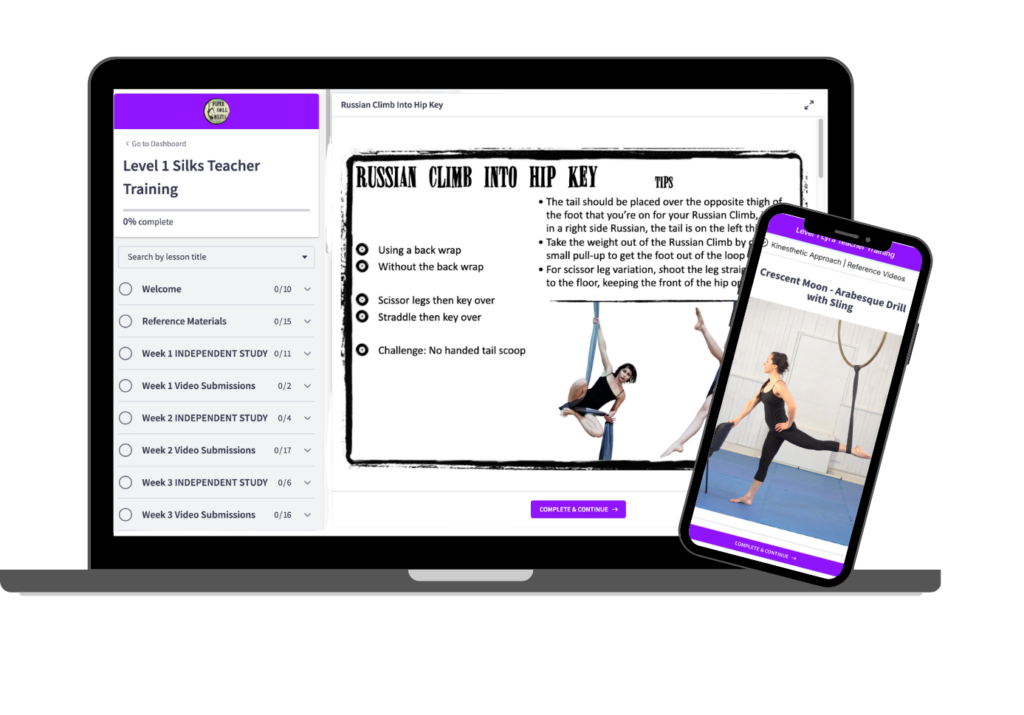
Choose Your Apparatus Track
Silks | Lyra | Trapeze | Rope
Before You Enroll: What You’ll Need
What is included in the 50 hour course?
Independent Study
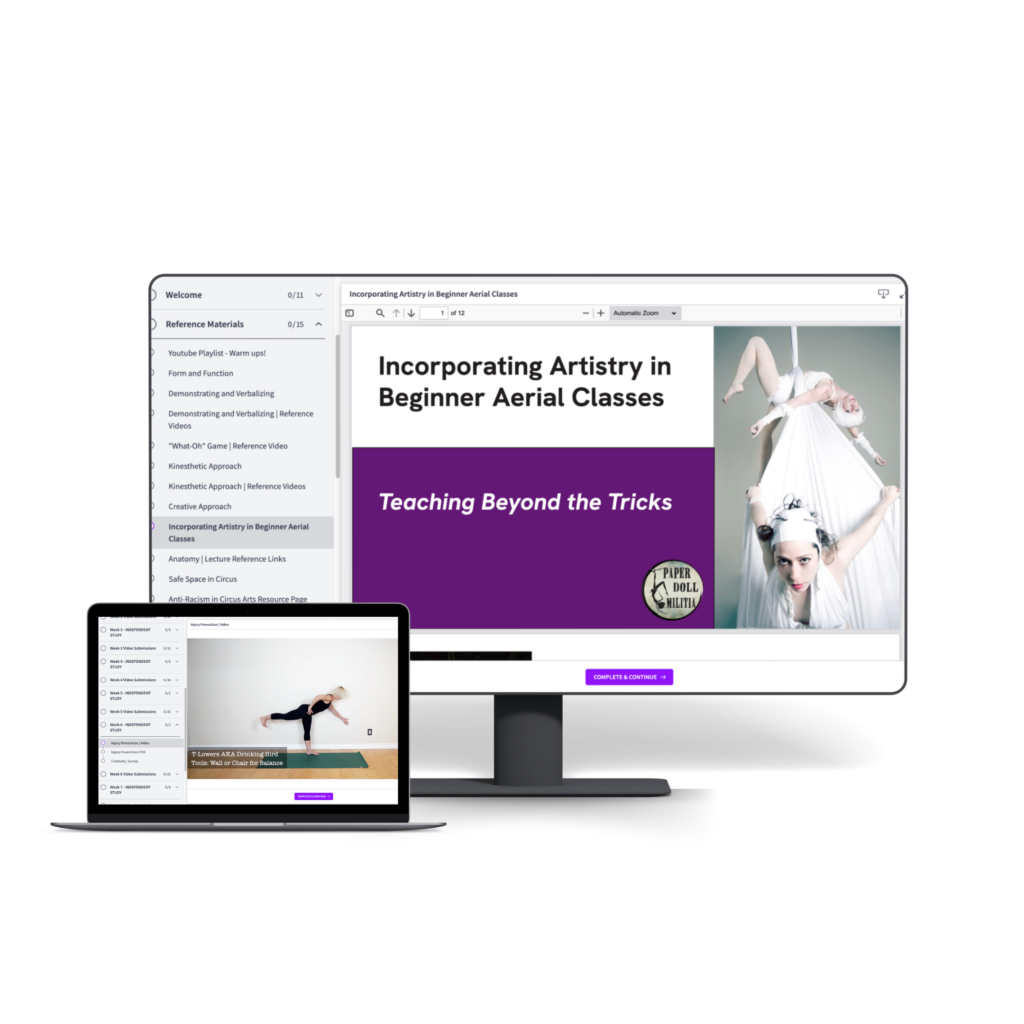
Short, focused modules you can complete at your own pace, but guided by a clear weekly schedule that aligns with our live Zoom sessions. Lectures and readings that cover foundational concepts like rigging, safety, functional anatomy, injury prevention, class management, spotting theory, and our Vertical Theatre Method.
*Course books: Applied Anatomy of Aerial Arts and The Aerial Teacher’s Handbook
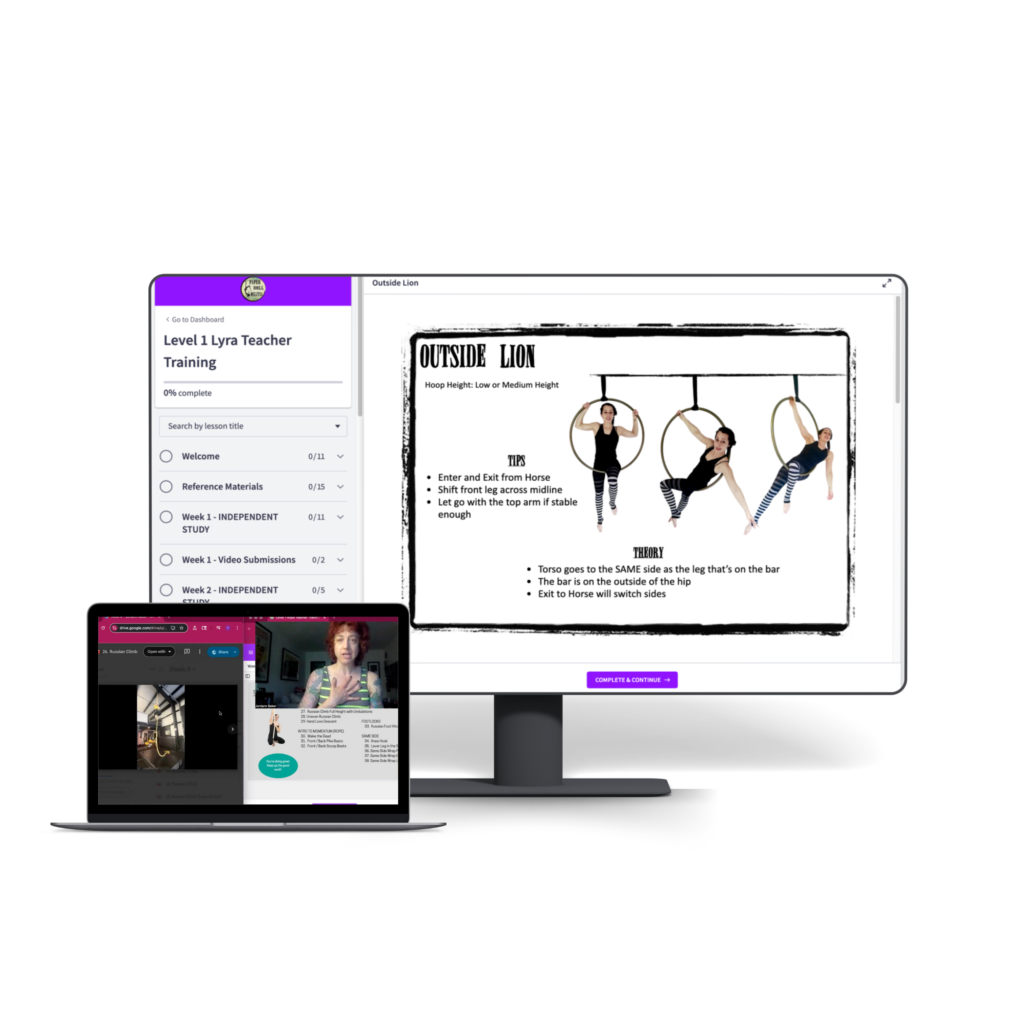
Video Submission Practice
You’ll film weekly skills assignments on your apparatus. For each skill you’re given a narrated tutorial, reference videos, and a downloadable PDF that outlines clear progressions, drills, and teaching tips.
You choose when to film each week. As long as you meet the weekly deadlines, your studio schedule can be flexible. You’ll submit your videos and your dedicated instructor will provide personalized feedback to guide your development and support your growth.

Live Zoom Classes
Weekly 2-hour sessions held in multiple time-zone groups. These interactive group calls include discussions, practice teaching, and movement labs. They’re a space to ask questions, connect with your cohort, and deepen your understanding through real-time support and collaborative learning.
Live participation is encouraged. You can miss up to 3 out of 8 sessions and make them up with replays and submitted assignments.
The Nitty Gritty
For all you planners out there, this section is for you. Explore the ins and outs of how this course is delivered, so you can plan your Teacher Training journey with ease.
When You’ll Need Your Aerial Space
The course requires regular access to a safe aerial training space.
💻 Zoom Classes
• Call 1 – No apparatus needed
• Call 2 – Apparatus or pull-up bar
• Calls 3 – 7 — Apparatus required
• Call 8 – No apparatus needed
In short: You’ll need access to your aerial space for Calls 3–7 only.
🎥 Video Submission Process
This starts in Week 2 and runs through Week 8. You’ll need about 3–4 hours of studio time each week, for a total of 22 hours over 7 weeks.
Rigging Requirements
You’ll need access to a safe aerial setup that meets ACE-recognized standards.
In your application, you’ll include:
• What your aerial point is attached to (rig, building structure, or custom install)
• A short description of your setup and hardware
• Information and/or documents that reflect approval and load limits from a qualified rigger or engineer*
• Clear photos of your rigging and crash mats
*Official documents aren’t required — we may simply ask a few clarifying questions to ensure your space meets safety standards.
Crash Mat Requirements
These are required for all training levels during both filming and Zoom practice.
Level 1:
Thickness: 4 inches / 10 cm
Shortest side: 4 ft / 122 cm
Level 2:
Thickness: 8 inches / 20 cm
Shortest side: 4 ft / 122 cm
Note:
Bed mattresses are not accepted as they are not designed for shock absorption.
Panel mats are not designed for falls. Stacking tumble track, puzzle mats, or
panel mats is not considered safe practice for aerial activities.
Minimum Height Requirements
• Level 1 Silks – 10 ft / 3m
• Level 1 Rope – 12ft / 3.8m
• Level 1 & 2 Lyra – 12ft / 3.8m
• Level 2 Silks & Rope – 13ft / 4m
• Level 1 & 2 Trapeze – Variable* absolute minimum 12ft / 3.8m
*Minimum height depends on trapeze rope length. Ropes can be shortened with a prusik knot unless your trapeze has a steel or amstel core. If it does, consult the manufacturer.
Safety Person
Anytime you are in the air, during Zoom classes or while filming, someone must be physically present in the building who can assist in an emergency. They don’t need aerial experience; they simply need to be able to see you and call for help if needed.
You do not need a safety person for Zoom calls 1, 2, 5, and 8.
The Audition Process
We cover a lot of skills in our courses! To prevent injury and inspire physical longevity, we encourage you to develop foundational strength, body awareness and technique before attending our course. Therefore, we require all participants to pass an audition process to be eligible to attend.
If you are unable to complete the audition pre-requisite skills with proper form and alignment, you will be given specific feedback and allowed one refilm submission. If you are still unable to pass the audition process you will be welcome to re-apply for a future training.
Click here for a downloadable PDF with the apparatus-specific skill lists required for your audition.
Core Training Track vs. Certification Track
Choose whether you want training only or to pursue a formal teaching certification.
Core Training Track
→You complete the Teacher Training (Level 1 or Level 2).
→You receive a Letter of Completion.
*This track is ideal if you want skills, structure, and teaching tools without the additional practicum and assessment requirements.
Certification Track
→You complete the Teacher Training plus additional practicum and assessment hours that confirm you can apply the material in real teaching settings.
See more detailed information about the Certification Track below.
*This track is great for instructors seeking a formally recognized credential that supports both career growth and studio opportunities.
Still have a question?
Just shoot us an email and we’d be happy to help!
Paper Doll Militia Teaching Certification
The Certification Track shifts you from “I’ve learned this” to “I can teach this.”
The Certification Track is a structured process that confirms you can apply what you learned in the Teacher Training in real teaching environments.
You’ll put your training into practice through observation hours, supervised teaching, and in-depth assessments.
It’s a hands-on pathway that validates your skills and shows you’re ready to lead with professionalism and care. This is what earns you an official PDM Certification.
In a field where training pathways vary widely, a PDM Certification stands out as a vetted, reputable credential recognized by studio owners and insurers for its depth of training and high-quality teaching practices.
Certification
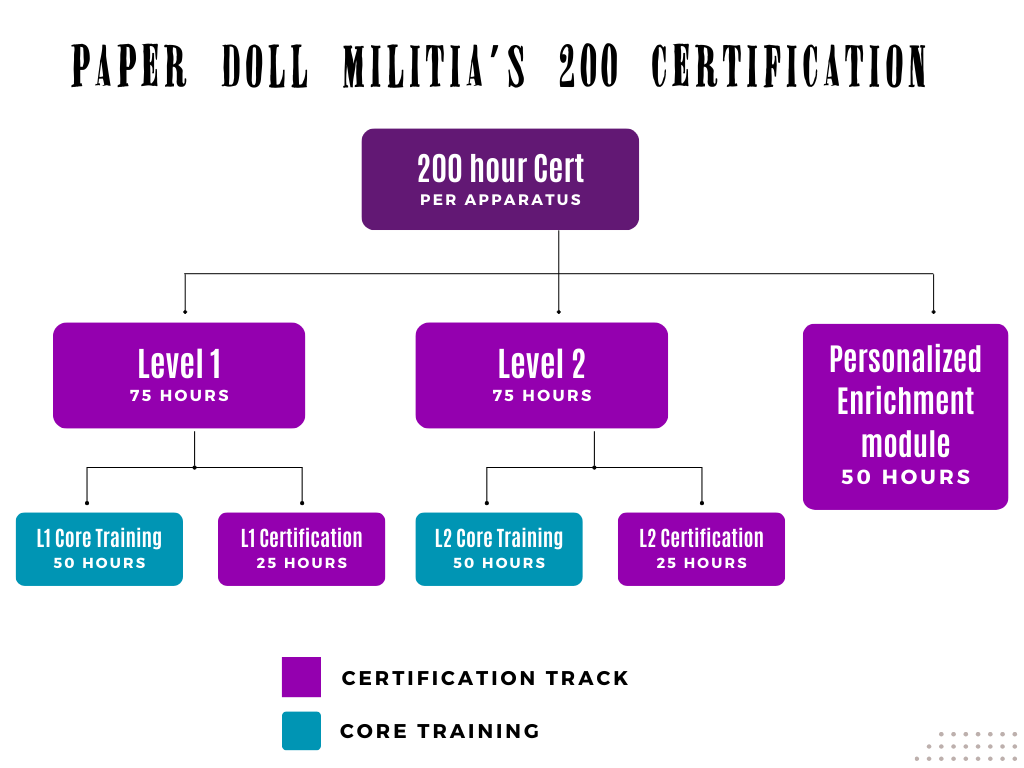
75 hours per level/per apparatus
To earn your certification in Level 1 or Level 2, you complete:
*In order to receive your certification, you must pass the skills assessment portion of the core training course.
200-Hour Certification
If you complete both Level 1 (75 hours) and Level 2 (75 hours) for the same apparatus, you can continue toward the full 200-Hour Certification.
Final 50 Hours: Personalized Enrichment Module
This is where you refine your niche!
You’ll work 1:1 with a PDM mentor to define your customized focus area and map out the practicum experiences that will support it.
Examples include:
No two PEMs look the same. Trainees create unique pathways that draw from their interests and experiences. Recent examples include;
How will you customize your certification journey?