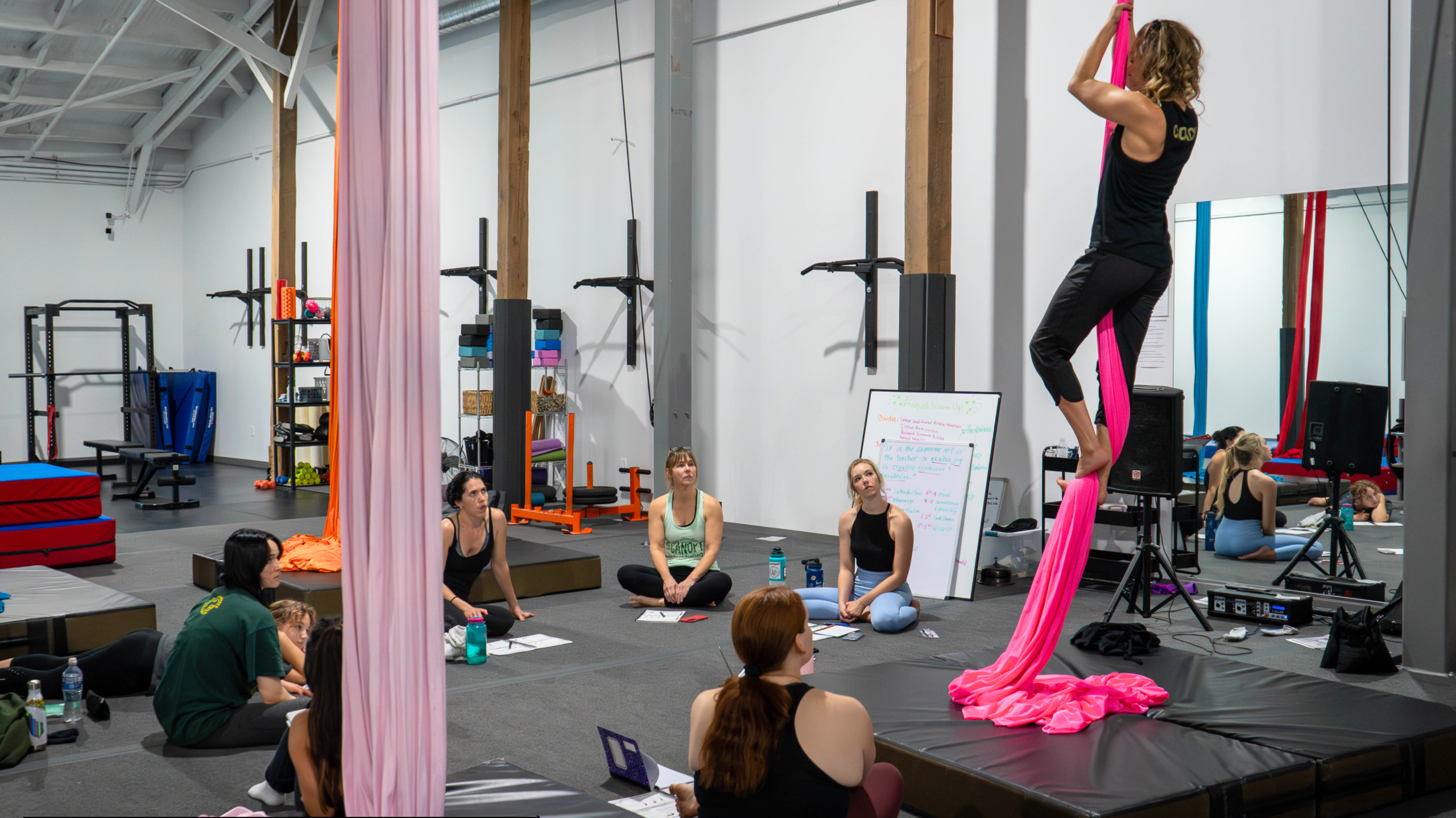
Who should pay for Teacher Training?
Hey studio owners and instructors, we see you. . .
If you run a studio, you are some of the hardest working people in this industry, and honestly, some of the most under-appreciated. You keep the lights on, hold the space, and show up for your coaches and students, often while running on fumes.
If you’re a coach, you’re probably carrying your own version of that: building your skills, saying yes to classes, and wondering how to afford the training that makes you better at what you do.
Either way, this question probably sounds familiar: HOW can I pay for teacher training and potentially the question may also arise WHO should pay for teacher training?
It’s a question a lot of people quietly wrestle with. This industry is still the wild west. There’s no established playbook, no shared convention, just a lot of people in a lot of different corners of the world doing their best to figure it out as they go.
Teacher training makes coaches better, safer, and more confident. This benefits the studio immensely, resulting in a positive learning environment, fewer incidents, and better student retention. For instructors, it opens doors to new opportunities, strengthens their credentials, and builds skills they’ll bring with them wherever they teach. Both sides benefit, it makes sense to think of the cost as something that could be shared.
How shared? These questions can help.
Does the coach teach only for one studio, or for several?
The more exclusive the relationship, the more the studio benefits, and the more of the cost it makes sense for the studio to carry.
Is there a commitment on both sides?
Training a coach with guaranteed hours and a long-term role is a different investment than training someone who picks up the occasional class. Commitment is what makes a bigger studio investment feel safe.
Is the training required or optional?
If the studio requires the training for safety, liability, or a consistent standard of teaching, it works more like equipment or insurance. It’s the cost of running the business. If it’s optional career development, a shared cost is more natural.
Is the training specific to the studio, or does it follow the coach everywhere?
Studio-specific methods are more the studio’s to fund. A credential that travels with the coach is more of a shared investment.
Seven Ways to Share the Cost
Whatever you land on, we’d encourage starting by deciding what portion the studio can cover, even if it’s small, and then choosing how the rest is handled.
1. Studio Subsidy
Shared Upfront Costs
A straight subsidy of a portion of the training, given as a gift with no payback. The coach takes on only the remainder, through any of the options below. This is the most generous place to start, and it can be layered onto every other model on this list.
2. Pro-rated commitment
Studio Investment or Shared Upfront Costs
The studio covers the full cost or a portion of the cost upfront, and the coach agrees to stay for a set period (say, 18 months). If they leave early, they repay a portion based on the time remaining. It’s often kinder than asking a coach to front the money, and it protects the studio’s investment in a way that feels fair to both sides.
3. Work Exchange
Studio Investment
The studio covers training, and the coach contributes hours in exchange by assisting or subbing classes, proctoring open gym, or working the front desk. If you go this route, value those hours fairly and make sure it’s something the coach chooses, not something that feels expected.
4. Milestone reimbursement
Coach Investment – Studio Reimburses
Tie reimbursement to outcomes. Certificate complete? Reimbursed . First 10 classes taught? Reimbursed. A class hits its target enrollment? Reimbursed. The reimbursement can be partial or full. The studio pays for what actually happens.
5. Tiered reimbursement
Coach Investment – Studio Reimburses
Studio reimburses a percentage the longer they stay: 25% at 6 months, 50% at 12, 100% at 24.
6. Pay-bump incentive
Coach Investment
Once the coach is certified they earn a higher pay rate for as long as they’re with the studio. It’s a lovely gesture and a clear way to honor growth.
7. Studio credit
Coach Investment
Studio offers membership credit, free classes, or open-studio time as credit to help offset part of the cost. It’s a low-cost way to give something that still feels meaningful.
A Quick Note Before You Decide
Rules around paid training time, work-trade, and repayment agreements vary by location, and some are more restricted than you’d expect. It’s worth checking your local labor rules (or talking with your accountant or an employment resource) before you put anything in writing.
One More Way to Lower the Cost: Group Perks
Everything above focuses on how studios and coaches share the cost of teacher training. But the overall price of the training is worth considering, too.
Some training providers offer incentives to studios that enrol multiple coaches. At Paper Doll Militia, for example, we’re introducing a new incentive program for our 2027 teacher trainings to help make training more accessible for studios and their teams.
Group enrollment from the same studio comes with built-in extras:
- 3 staff attend: studio owner or manager attends free
- 4 staff attend: a free studio owner support mentorship session
- 6 staff attend: a private Zoom group session arranged just for your studio
Sending a team also means your coaches train together, share the same language and standards, and can support each other afterward.
The Takeaway
You don’t need a perfect budget to invest in your coaches. You need a model that fits where your studio is right now, and that feels fair to the people you’re asking to grow with you. When coaches feel invested in, they tend to invest right back.
Coaches: if you’re reading this, feel free to share it with your studio owner as a conversation starter.
Studio owners: if you’ve found a creative way to do this in your own studio, we’d genuinely love to hear it. This industry grows when we share what’s working. 💜
Curious about our teacher trainings?